
Synthetic Monitoring vs. Real User Monitoring
Explore the differences between Synthetic Monitoring and Real User Monitoring to optimize application performance and enhance user experiences.

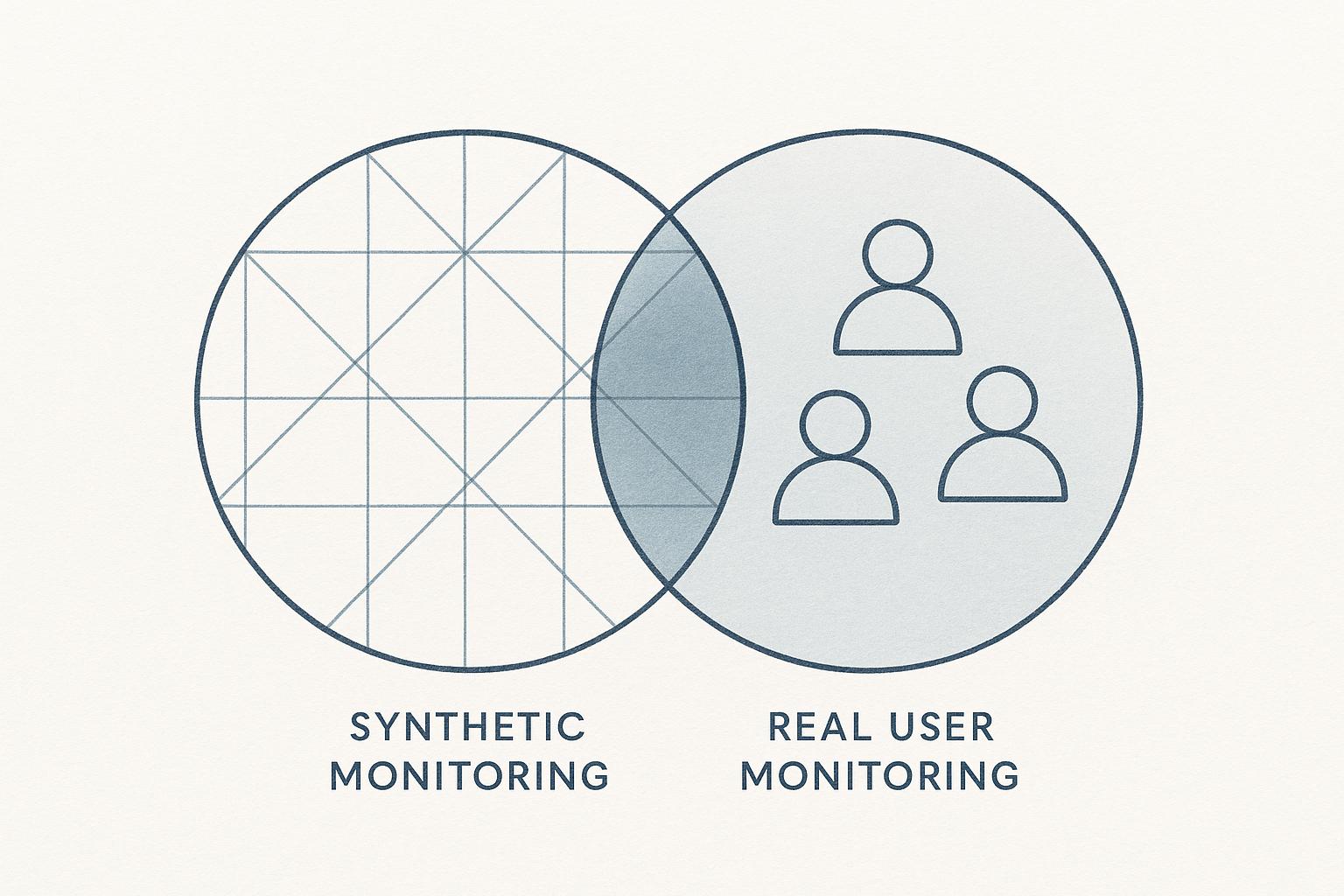
When it comes to keeping your applications running smoothly, two monitoring methods stand out: Synthetic Monitoring and Real User Monitoring (RUM). Both help track performance, but they do so in very different ways:
- Synthetic Monitoring: Uses automated scripts to simulate user interactions, testing your app in controlled conditions. It’s great for catching issues early and ensuring uptime, even when no real users are active.
- Real User Monitoring (RUM): Collects data from actual user sessions, offering insights into how your app performs in real-world conditions across devices, networks, and locations.
Each has its strengths. Synthetic monitoring is ideal for proactive testing and benchmarking, while RUM provides insights into user behavior and satisfaction. Combining both gives you a complete picture of your app’s health, helping you resolve issues faster and improve user experiences.
Quick Comparison:
| Aspect | Synthetic Monitoring | Real User Monitoring (RUM) |
|---|---|---|
| Type | Automated, scripted tests | Data from real users |
| Environment | Controlled | Dynamic |
| Coverage | Predefined scenarios | Broad user interactions |
| Timing | Scheduled | Continuous during sessions |
| Best Use | Pre-release testing, uptime checks | User experience insights |
For the best results, use both methods together. Synthetic monitoring ensures reliability, while RUM helps you understand and improve user satisfaction.
Synthetic monitoring vs real user monitoring (RUM): what’s the difference?
What is Synthetic Monitoring
Synthetic monitoring relies on automated scripts to mimic user interactions with your application. These scripts simulate specific user journeys continuously, regardless of actual traffic. By actively probing your systems, synthetic monitoring helps identify issues - such as a malfunctioning payment gateway - before they impact your customers. This proactive approach allows you to address problems at any time, even during off-hours, ensuring a smoother experience for users.
How Synthetic Monitoring Works
Automated scripts perform pre-defined transactions, like loading pages, logging in, or completing purchases, at regular intervals. These tests are conducted from various data centers worldwide, measuring metrics such as response times, availability, and transaction success. If something goes wrong - like a payment gateway failing or slowing down - alerts are triggered immediately.
This consistent approach provides reliable performance data, helping you establish benchmarks and track trends over time. By standardizing these tests, synthetic monitoring becomes a powerful tool for maintaining and improving system performance.
Benefits of Synthetic Monitoring
One of the key advantages of synthetic monitoring is its ability to identify issues early, minimizing disruptions and keeping customers happy. For businesses where downtime is not an option - like a law firm racing against a filing deadline or a manufacturing company managing inventory during peak production - it’s a game-changer.
Synthetic monitoring also enables precise performance benchmarking. Because tests are run under controlled conditions, you can establish accurate baselines and measure the impact of system upgrades or optimizations. Additionally, it allows you to simulate different environments, testing how your application performs under various network conditions and user scenarios.
With monitoring running 24/7, your systems remain protected even when your team isn’t on the clock. This constant vigilance is especially critical for industries like healthcare or government services, where compliance and service level agreements are non-negotiable. However, while synthetic monitoring offers numerous benefits, it’s not without its challenges.
Drawbacks of Synthetic Monitoring
Like any tool, synthetic monitoring has its limitations. The most notable drawback is its inability to account for the unpredictability of real user behavior. Actual users may take unexpected actions or follow unconventional paths that scripted tests don’t anticipate, leaving some edge cases undiscovered.
Maintaining and updating scripts can also be resource-intensive, especially for applications that evolve rapidly. This ongoing effort can add to the workload of your development or IT teams.
Another challenge is that synthetic monitoring only follows predetermined paths, which means it might miss issues that arise under unique, real-world conditions. While it can confirm that processes are completed within acceptable timeframes, it doesn’t provide insights into how users feel about their experience.
For industries like aerospace, manufacturing, or accounting - where Integrity Tech offers tailored IT solutions - these limitations highlight the importance of combining synthetic monitoring with other strategies. A multi-faceted approach ensures broader coverage and a more comprehensive understanding of system performance.
What is Real User Monitoring (RUM)
Real User Monitoring (RUM) is all about collecting live data from real users as they interact with your application. It tracks metrics across different devices, browsers, and network conditions - whether someone is shopping on their phone during a commute or using desktop software in a remote office setting. The beauty of RUM is that it works quietly in the background, capturing user experiences without disrupting them. This hands-off approach provides a clear and unfiltered view of how users engage with your application.
How Real User Monitoring Works
RUM relies on small tracking agents embedded within your application or web pages. These agents operate invisibly, collecting data as users navigate your system. The process is seamless, so users remain completely unaware of the monitoring.
These agents gather a wide range of metrics: API response times, page load durations, transaction success rates, DNS and network latency, and even detailed user behavior patterns. Unlike synthetic monitoring, which uses pre-written scripts, RUM captures actual user interactions, offering a more authentic view of performance.
The data collected is then automatically segmented by user demographics, device types, browsers, and geographic locations. For companies serving diverse audiences - like those in aerospace, manufacturing, or government sectors supported by Integrity Tech - this segmentation provides invaluable insights into how different groups experience the application.
Benefits of Real User Monitoring
RUM offers a complete picture of user satisfaction. While synthetic monitoring ensures systems are functioning as expected, RUM goes a step further by revealing whether users are genuinely enjoying their experience. It tracks metrics like bounce rates, session lengths, and conversion rates to uncover real-world performance issues.
One of RUM's standout features is its ability to provide geographic and demographic insights. For instance, it might highlight that users in a specific region face slower load times due to local network limitations or that customers with older devices encounter issues missed during controlled testing. This level of detail allows businesses to prioritize fixes that have the greatest impact on users.
RUM also excels at spotting problems that scripted tests might miss. By monitoring every interaction, it can identify unique issues caused by specific combinations of devices, browsers, or network conditions. Plus, as your application evolves with new features or updates, RUM immediately begins tracking how users respond to those changes. This adaptability makes it a valuable tool for maintaining high performance and user satisfaction.
Drawbacks of Real User Monitoring
Despite its advantages, RUM has some limitations. For one, it depends on live user activity. If traffic is low, there may not be enough data to identify potential issues, meaning problems could go unnoticed until they impact real users.
Another challenge is troubleshooting. Since RUM captures data from a wide range of variables - like devices, browsers, and network conditions - pinpointing the exact cause of an issue can be tricky. While it shows that a problem exists and identifies affected users, further investigation is often needed to determine the root cause.
RUM also has blind spots. It only monitors interactions that actually occur, so less frequently used processes - such as administrative tasks or disaster recovery procedures - might go untracked until something goes wrong. This can be a concern for industries like healthcare, government, or manufacturing, where certain workflows are critical. While RUM is a powerful tool, these challenges highlight the importance of using it alongside other monitoring methods for a more comprehensive approach.
sbb-itb-f3ffd9f
Synthetic Monitoring vs Real User Monitoring: Key Differences
Synthetic monitoring and real user monitoring (RUM) play distinct roles in ensuring application performance. Knowing how they differ is crucial for crafting a well-rounded monitoring strategy.
The main difference lies in their approach. Synthetic monitoring is proactive, running scripted transactions on simulated devices to test specific scenarios - even when no users are active on your platform. In contrast, real user monitoring takes a reactive approach, tracking actual user interactions to provide real-world performance insights.
Another critical distinction is the environment. Synthetic monitoring operates in a controlled setting where variables like geography, network conditions, and device types remain consistent. This predictability makes it easier to pinpoint issues without interference from external factors. On the other hand, RUM captures performance in unpredictable, real-world conditions, where network congestion or device-specific quirks can heavily influence results. This difference highlights the contrast between controlled testing and real-world variability.
Timing is another key factor. Synthetic monitoring delivers immediate feedback during development phases, while RUM continuously gathers data from live user interactions, offering insights over time.
Comparison Table
| Aspect | Synthetic Monitoring | Real User Monitoring |
|---|---|---|
| Monitoring Type | Active, scripted tests | Passive, real interactions |
| Data Source | Simulated devices in controlled environments | Real users on actual devices |
| Environment | Predictable and controlled | Dynamic and unpredictable |
| Testing Schedule | Scheduled intervals (e.g., every 5 minutes) | Continuous during user sessions |
| Primary Focus | System performance and health | User experience and satisfaction |
| Geographic Coverage | Multiple test locations, no demographics | Insights by location and demographics |
| Issue Coverage | Predefined scenarios | Broad range of real interactions |
| Adaptability | Requires script updates for app changes | Adapts to user behavior automatically |
| Availability | Runs 24/7, even without user traffic | Relies on actual user activity |
| Best Use Case | Pre-production testing and proactive detection | Production monitoring and user experience optimization |
When to Use Each Method
Synthetic monitoring is ideal for controlled testing and proactive issue detection. It’s particularly useful in pre-release stages to catch problems before they affect users. For example, you can use it to test critical workflows like logins, checkout processes, or other key transactions in a consistent and repeatable way. Synthetic monitoring is also essential for uptime monitoring and SLA compliance, as it provides round-the-clock insights - even during low-traffic periods.
This method is especially valuable for testing rarely accessed features or edge-case scenarios. Industries like aerospace, manufacturing, or government often depend on administrative or compliance workflows that might not see frequent use but are still critical. Synthetic tests ensure these functions remain operational.
Real user monitoring, on the other hand, becomes indispensable once your application is live. It provides a clear picture of how different user groups experience your app on various devices, browsers, and networks. RUM is particularly effective for tracking long-term trends and assessing the impact of updates or new features.
If your goal is to optimize user engagement - such as reducing bounce rates, increasing session duration, or improving conversion paths - RUM delivers the behavioral data you need. It’s also invaluable for businesses serving diverse markets, as it highlights region- or demographic-specific performance issues.
The Power of Combining Both
Neither synthetic monitoring nor RUM alone can provide a complete view of application performance. Synthetic monitoring sets reliable baselines and identifies regressions, but it can’t reveal how users feel about their experience. RUM, while offering real-world insights, may miss issues that controlled testing could uncover.
The best strategy blends both methods. By combining synthetic monitoring’s precision with RUM’s authentic user data, you can create a monitoring framework that covers all bases - ensuring both technical performance and user satisfaction are addressed.
Using Both Methods Together
To get the best results from performance monitoring, combining synthetic monitoring with real user monitoring (RUM) is key. This approach balances the proactive capabilities of synthetic monitoring with the real-world insights of RUM, creating a well-rounded strategy that catches issues early while validating their impact on actual users.
Benefits of Combining Both Methods
Merging synthetic monitoring's predictive tests with RUM's real-world data creates a feedback loop that enhances your monitoring efforts. For example, if synthetic tests show no issues but RUM highlights problems, you might need to investigate factors like mobile compatibility or regional network challenges. On the flip side, if synthetic monitoring flags an issue that RUM reveals has minimal user impact, you can prioritize fixes based on their actual business impact.
Synthetic monitoring establishes technical benchmarks and identifies regressions, while RUM provides insights into how those issues affect user behavior. Together, they help teams make smarter decisions about performance improvements and feature rollouts.
This dual approach also reduces the time it takes to resolve issues. By correlating synthetic test failures with RUM data, teams gain a clear view of both technical performance and user experience, enabling faster troubleshooting. In fact, organizations using this strategy have reported up to a 30% reduction in critical incident response times, along with noticeable improvements in conversion rates.
By bridging technical performance and user experience, this approach becomes invaluable across various industries.
Industry Applications
The combination of proactive and real-world monitoring has practical applications across many fields, helping industries ensure both technical reliability and strong user engagement.
In aerospace, synthetic monitoring ensures system availability and compliance with regulatory standards, while RUM tracks how engineers and operators interact with control systems during real-world operations. This ensures both technical accuracy and operational efficiency in critical scenarios.
Manufacturing firms use this strategy to maintain production uptime and improve workflows. Synthetic monitoring ensures production systems and IoT devices are always functional, while RUM identifies bottlenecks or interface issues that could slow down operators.
Law firms benefit by protecting sensitive client data and delivering smooth digital experiences. Synthetic monitoring ensures client portals and case management tools remain secure and operational, while RUM provides insights into how attorneys and clients use these systems, highlighting areas for enhancement.
For government agencies, this dual approach ensures citizen-facing applications meet security and accessibility requirements. Synthetic monitoring checks for compliance, while RUM provides data on how users from different locations and devices interact with these services.
In accounting and CPA firms, the approach ensures financial software remains reliable and compliant. Synthetic monitoring continuously tests critical tools like tax preparation software, while RUM captures real-time user interactions during high-demand periods, helping optimize workflows and meet regulatory standards.
Conclusion
For businesses where uptime plays a critical role, combining synthetic monitoring with real user monitoring ensures both top-notch application performance and satisfied users. Synthetic monitoring uses controlled tests to catch potential issues early, while real user monitoring reveals how applications perform in live environments.
By integrating these two methods, you gain a well-rounded understanding of performance - leading to quicker issue resolution, smarter decisions, and better results.
Key Takeaways
Synthetic monitoring involves running scripted actions in controlled settings, while real user monitoring (RUM) captures live user interactions and behavior.
Each method has its strengths and limitations. Synthetic monitoring excels at offering consistent, proactive testing and identifying regressions before deployment. However, it might miss issues that only surface during real-world use. On the other hand, RUM adapts to actual user behavior and captures genuine experiences, though it tends to be more reactive.
Successful organizations often combine both approaches. Synthetic monitoring helps with early detection and benchmarking, while RUM provides insights for ongoing improvement and validation in real-world scenarios. Together, they create a feedback loop that identifies potential issues early and verifies their impact on users.
When tracking metrics, focus on a combination of technical and user-centered indicators. Synthetic monitoring should prioritize uptime, response times, and error rates, while RUM can highlight user satisfaction, conversion rates, and session duration. This dual approach ensures both system reliability and a positive user experience.
How Integrity Tech Can Help

Effective monitoring requires both technical know-how and a deep understanding of business needs. Integrity Tech offers real-time network monitoring and proactive solutions to ensure your systems stay reliable and perform at their best.
With Integrity Tech's consultation and assessment services, your organization can identify its unique monitoring requirements and create a customized strategy that blends synthetic and real user monitoring. Their expertise spans industries like aerospace, manufacturing, law, government, and accounting - where reliability and compliance are mission-critical.
Integrity Tech provides 24/7 support, proactive monitoring, and early issue detection. Their solutions deliver real-world insights without disrupting your operations. Plus, their managed IT services ensure seamless implementation and maintenance of these systems.
"Integrity Tech is an amazing company that cares. Phone customer service and field tech's are extremely patient and friendly. Brandon has been our go-to from day one. Thank you all for taking great care of us and responding quickly to our needs." - Sylvia Torrs, Happy Client
Whether you're setting up your first monitoring solution or refining an existing one, Integrity Tech's tailored IT solutions help you strike the perfect balance between proactive synthetic monitoring and real user insights. This combined approach ensures your applications remain reliable and user-friendly.
FAQs
What are the benefits of combining Synthetic Monitoring and Real User Monitoring for better application performance and user experience?
Combining Synthetic Monitoring with Real User Monitoring (RUM) creates a well-rounded strategy for improving application performance and keeping users happy. Synthetic Monitoring works by simulating user interactions in a controlled setting, allowing you to spot potential problems - like slow load times or outages - before they affect actual users. Meanwhile, RUM focuses on real-world data, tracking how actual users interact with your application and what their experiences look like.
Using both approaches together means you can catch issues early through simulations while also gaining valuable insights from real user behavior. This combination helps you minimize downtime, enhance the user experience, and focus your efforts on updates that make the biggest difference in real-life scenarios.
When might Synthetic Monitoring fail to detect issues that Real User Monitoring can identify?
Synthetic Monitoring relies on simulated user interactions to evaluate system performance. While this approach is great for proactive testing, it has limitations. It might not catch issues tied to specific user behaviors, unique device setups, or regional network challenges - factors that only real users encounter.
In contrast, Real User Monitoring tracks actual user interactions, offering a more accurate picture of real-time performance. For instance, it can highlight slow load times for users in certain regions or errors caused by unusual usage patterns. While Synthetic Monitoring is useful for anticipating problems, Real User Monitoring shines by revealing how your system behaves under real-world conditions.
How does Real User Monitoring respond to changes in user behavior and application updates?
Real User Monitoring (RUM) works by gathering real-time data directly from users as they interact with your application. This means it can spot changes in user behavior - like shifts in how people navigate or use specific features - and reveal how updates to your app affect their overall experience.
With this information, RUM enables you to make smarter decisions about improving performance, fixing potential problems, and keeping your application aligned with user needs. Its constant stream of real-world insights helps ensure your app delivers a smooth and satisfying experience over time.
Related Blog Posts
Related Blogs
.svg)
Ready to Transform
Your Customer Management?
Sign up today and see the difference Syncro can make for your business.